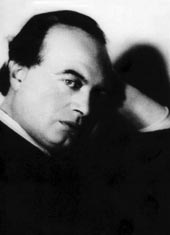
| Franz Werfel (1890-1945)
poet & Alma´s husband no.3 Listen to Franz Werfel's voice:
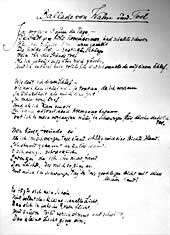
Werfel recites some of his poems
Der schöne Strahlende
Elternlied
Der Wanderer kniet
Lächeln Atmen Schreiten
When, in November 1917, Alma became acquainted with the young poet Franz Werfel, the person she described as a »fat bow-legged Jew with bulging lips« did not displease her at all; indeed, a passionate liaison erupted between them. Werfel, who was eleven years younger, saw in Alma his saviour, his goddess, someone whom he was allowed to worship. As often as possible, Alma visited him in his room at the Hotel Bristol, and after they had made love, she would mercilessly despatch him back to his writing desk. At the beginning of 1918, Alma, who still bore her married name of Gropius, became pregnant. The baby was born prematurely, since Werfel was unable to hold back his insatiable lust and forced the child out of his loved one´s womb in a veritable bloodbath. Ten months later, baby Martin was dead, a consequence of Werfel´s »degenerate seed«, as Alma put it. All the same, she spent a lifetime caring for her »Franzl«; he was »a tiny bird in her hand«, who needed her protection. It was thanks to Alma´s stimulating ambition that Werfel achieved his international career, which climaxed in the novel »The Forty Days of Musa Dagh« and the works filmed by Hollywood, »The Song of Bernadette« and »Jacobowsky and the Colonel«.
|
The seizing of power by the Nazis and the prohibition of his works forced Werfel to flee with Alma, whom he had married in 1929, via France into exile, which finally took them to Hollywood. Although his interest in the work of the Jewish pioneers took him to Palestine in 1924, he did not participate in the creation of the Jewish state. Robbed of his cultural roots, he died in Hollywood in 1945, an embittered man. He was buried in a smoking jacket and silk shirt, with a second shirt to change, and his spectacles in his jacket pocket.
Czech-born poet, playwright, and novelist, whose Werfel's best-known works include The Forty Days of Musa Dagh (1933), a classic historical novel that portrays Armenian resistance to the Turks, and The Song of Bernadette (1941). The latter book had its start when Werfel, a Jew escaping the Nazis, found solace in the pilgrimage town of Lourdes, where St. Bernadette had had visions of the Virgin. Werfel made a promise to "sing the song" of the saint if he ever reached the United States. He died in California in 1945. Franz Werfel was born in Prague, Bohemia, as the son of a wealthy glove merchant. While still a gymnasium student, he met Franz Kafka and Max Brod. Like Kafka, Werfel was a German-speaking Jew and never forgot his Jewish background. His central themes were religious faith, heroism, and human brotherhood. Werfel's first verse collection, "Der Weltfreund" (1911), was an euphoric celebration of human brotherhood. "My only wish is to be related to you, O Man!" he wrote in a poem. Werfel's work created a sensation and became a landmark in the history of expressionism. On the eve of World War I he was active in a pacifist society which he organized together with Martin Buber, Gustav Landauer, and Max Scheler. From 1915 to 1917 Werfel served in the Austrian army on the Russian front. He was transferred to the war press bureau in Vienna, but his outspoken pacifism led to a charge of treason. Werfel's poems about the war appeared in 1919 under the title "The Day of Judgment" (Der Gerichtstag) and revealed his despair of mankind. After the war Werfel worked as a full-time writer, and turned more and more to the drama and the novel. His plays were especially popular in England and in the United States. Most of his plays were produced by Max Reinhardt. Werfel's verse trilogy DER SPIEGELMENSCH (1921) dealt with man's temptation to self-deification, his fall and salvation. JUAREZ UND MAXIMILIAN (1924), was a drama about the Hapsburg emperor of Mexico, Archeduce Maximilian. The play gained a great success. In the Theatre Guild production in New York, 1926, played Edward G. Robinson. Werfel's major novels dealt with music, history, and Catholic faith, although he never converted. PAULUS UNTER DEN JUDEN (1926) was set in the period when Christianity broke away from Judaism. VERDI: ROMAN DER OPER (1924) was about the famous Italian composer Giuseppe Verdi and dealt with artist's crisis when his creative powers fail. A trip in 1929 to the Middle East inspired "The Forty Days of Musa Dagh (1933). Werfel saw in a mat factory starving refugees, and became acquainted with their fate. Alma writes about the days in Damascus, 1929 in her memoirs "And the Bridge is Love“:"The owner (of the carpet-factory) guided us through his establishment. We walked along the weaver´s looms and everywhere we saw the starved out children, with pale El Greco-faces and over dimensioned dark eyes. They rolled upon the floor, took spools and might, sometimes, have swept the floor. Oh, these poor creatures, I collect them from the streets and I give them one piaster per day, so that they should not die from starvation. They are children of Armenians, slaughtered by the Turks. If I do not shelter them, they would die of hunger. Nobody cares for them. They can afford nothing, they are to weak... Werfel and I left the place, nothing from now on seemed to be of importance or beauty...“ Werfel started to write the book in July 1932, finishing it in March 1933. The story depicted the persecution of the Armenians by the Turks in 1915. Werfel warned prophetically about the consequences of the anti-Semitism of the Nazis. Alma and Franz Werfel fled Vienna in 1938 for France when Austria fell to the German army. In Paris the author suffered his first heart attack. In 1940, with the assistance of the American journalist Varian Fry in Marseille, the Werfels along with Heinrich Mann, his wife Nelly and his nephew Golo Mann fled by foot over the rugged Pyrenees to Spain, and from there to Portugal where they sailed to New York City, ultimately leaving Europe for the United States. Eventually they settled in California in 1940, where thwy lived in the Hollywood hills at 6900 Los Tilos Road. In September 1942 they moved to 610 North Bedford Drive in Beverly Hills. While in Southern California, Werfel completed his novel "The Song of Bernadette" (1941) thereby fulfilling his vow made in 1940 in Lourdes for a safe escape. In the preface Werfel stated that his intention is to 'magnify the divine mystery and the holiness of mankind'. The book was made into a successful Hollywood film in 1943 and won three Oscars. Jennifer Jones played Bernadette, a peasant girl in the 1800s, who has a vision of the Virgin Mary at what becomes the shrine of Lourdes.
Werfel also wrote his final play, Jacobowsky and the Colonel (1944; Jacobowsky und der Oberst), while in Southern California. Werfel's ability to work in the film industry made him one of the few financially successful émigrés. Franz Werfel died in Beverly Hills, California, on August 26, 1945, in the middle of his work, correcting galley proof of his last book of verse. Posthumously published "The Star of the Unborn" (1946) was a visionary science-fiction novel, in which Werfel's suspicion of 'civilization' also reflected his depressed experiences in exile in California. In the story the narrator's mysteriously resurrected self is summoned into the distant future. There the narrator (named Franz Werfel) is guided by a mentor and he observes the ultimate spiritual and technological development of the humankind. The end of suffering has not brought about a new golden age, but has cut off the chance to man's redemption. |